
Spirituality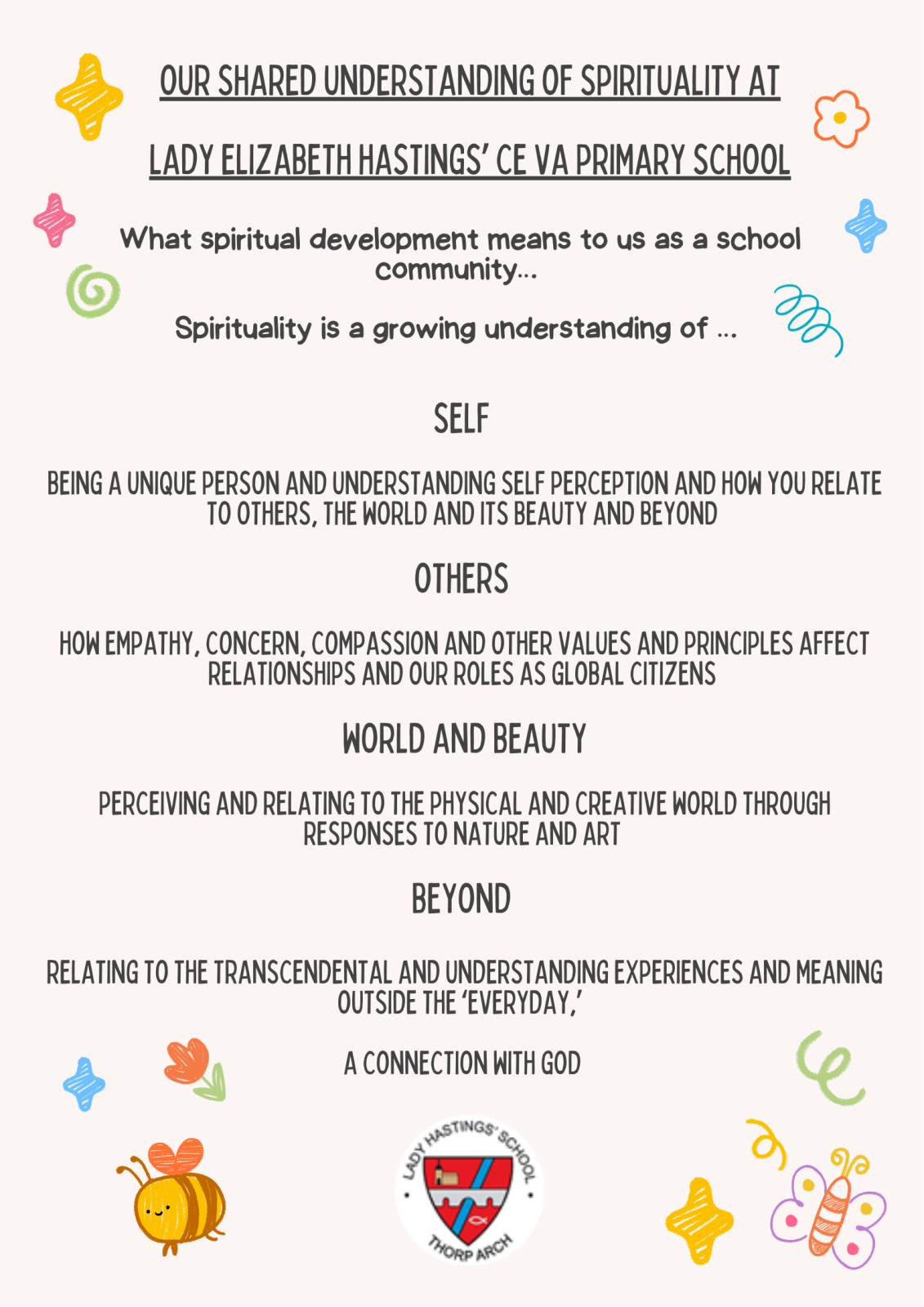
What is spirituality?
Spirituality is a difficult thing to define! At Lady Elizabeth Hastings' CE VA Primary School we believe it is fundamental to our mental and physical well-being (for children and adults too), but is not exactly the same as those things. It is not necessarily tied to a religious belief. People of faith and people of no faith can be deeply spiritual.
Spirituality is not something we can see or touch - we feel it inside all of us.
It might be a sense of awe and wonder.
It might be a sense of empathy and compassion. It might be a sense there are important questions to be asked which might not have obvious answers. It might make us want to laugh, cry, sing, be creative or be still.
We might have spiritual experiences with others or we might have them on our own. Spirituality is a sense of something bigger than ourselves
Our working definition of ‘spirituality’
' Spirituality is delighting in all things, being absorbed into the present moment, not too attached to self, and eager to explore boundaries of ‘beyond’ and ‘other’, searching for meaning, discovering purpose, open to more.'
(Dr. Rebecca Nye)
As a staff and governor team, we have agreed on a definition of spiritual development in our school community to support us as we talk about spirituality:
Spirituality can be defined as relational consciousness: awareness of my relationship with myself, others, the world and beyond (God).
We encourage spirituality using a framework developed by Andrew Rickett where the children reflect on:
Self
- being a unique person and understanding self-perception and how you relate to others, the world and its beauty and beyond
Others
- how empathy, concern, compassion and other values and principles affect relationships and our roles as global citizens
World and Beauty
- perceiving and relating to the physical and creative world through responses to nature and art
Beyond
- relating to the transcendental and understanding experiences and meaning outside the ‘everyday,’
- a connection with God
We support pupils in their spiritual development by:
- providing opportunities for spiritual development in collective worship
- providing opportunities for spiritual development in RE
- providing opportunities for spiritual development in the wider curriculum
- capturing opportunities for awe and wonder as planned moments and as they arise
- providing ‘reflection spaces’ in classrooms, public spaces, outside, and by using the church building, and through the ‘Prayer Spaces in School’ website
- offering pupils opportunities to develop their own spiritual leadership through leading collective worship
Spirituality across our curriculum
The Primary National Curriculum provides aims and purpose for all subjects. Spirituality and spiritual development are not directly referenced or planned for within the National Curriculum and therefore there are no pre-determined or agreed aims and purpose. To provide clarity and focus the following aims and purpose have been agreed at Lady Elizabeth Hastings' School:
- Enable children be reflective about their own beliefs (religious and beyond) and perspective on life.
- Develop curiosity and interest in, and respect for, different people’s feelings and values and how this will inform they way they act.
- Nurture and develop a sense of enjoyment and fascination in learning about themselves, others and the world around them and the world beyond them.
- Enable use of imagination and creativity in learning.
- Enable children to reflect on their experiences.
Opportunities for encouraging spirituality linked to the four areas of spirituality identified as self, others, world/beauty and beyond have been considered when planning our curriculum and are highlighted on each curriculum progression map.
Children have been taught explicitly about the meaning of the word spirituality and our relationship with self, others, world/beauty and beyond and spirituality continues to be a focus in our Monday values worship and our Wednesday class worship in which we ask 'Big Questions.'